The Coalition for Good Govenance Penang
The Coalition for Good Governance held its inaugural public forum entitled " Why A Freedom of Information Act?" on the 15th of May 2010 at Kompleks Masyarakat Penyayang in Penang.
The Chairperson and The Speakers
Some Members of The Audience
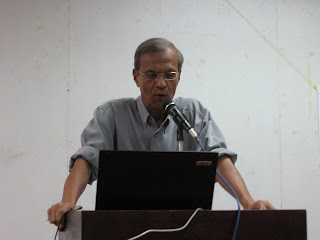
The Chair: Mr. Rajamoorthy
The Forum
The Chair and The Panel of Speakers.
The forum was chaired by Mr. Rajamoorthy, a senior lawyer with many years of active participation in social services. The speakers comprised of Ms Latheefa Koya, a lawyer, a city councillor for Majlis Perbandaran Petaling Jaya as well as the Information Chief of Parti Keadilan Rakyat; Ms Lim Kah Cheng, a lawyer and a city councillor of Majlis Perbandaran Pulau Pinang; Mr Himanshu Bhatt, Penang Bureau Desk of the Sun daily newspaper and Mr. George Aeria, the President of the Tanjung Bungah Resident Association.
The Audience
The forum was attended by about 200 participants, many of whom are young persons.
The Chairperson's Introduction :
The Worldwide Trend To Enact The Right To Information Act
Mr. Rajamoorthy gave a brief introduction to the concept of the Right To Information Bill. He stressed that more than 50 countries, including developing countries in Asia, have already enacted the Right To Information Bill. Many developing countries have realised that through the introduction of this Bill, their citizens are now able to have rightful access to information held at various levels of government. The access to such information has empowered their citizens to assert and reclaim their rights in the courts of law against unjust treatment and corrupt practices committed by errant civil servants and politicians.
This has helped to build a less unjust society where the unfairly treated can seek recourse to wrongs committed in secrecy by errant officials in both the public and private sectors who may be acting separately or in collusion.
The access to information has also directly encouraged the nurturing of a free press so that accurate and full disclosure of news will reach the public. A more open society thus created will deepen and broaden democratic practices in these countries.
Mr. Rajamoorthy cited India as a developing country that has taken a lead in this direction.

Mr. Himanshu Bhatt, Northern Bureau Desk, The Sun Daily
Himanshu Bahtt :
The Right To Information Act Will Enable A Free and Independent Press
Mr. Himanshu Bhatt explained that the freedom to access information is crucial to accurate reporting of news. Only with accurate and reliable reporting can the public trust the press.
He observed that prior to the March 8 general election, DAP and the Centre for Independent Journalism (CIJ) had called upon the federal government to enact a Freedom of Information Bill.
After the March 8 political tsunami, the public has demanded the Pakatan State governments to bring about more democratic changes. The current demand to introduce A Right To Information Bill is one such example.
He cited some examples in Penang to bring this issue into focus.
The Arches at The Penang Botanical Garden: Tilting or Optical Illusion?
The development project at the Penang Botanical Garden is being undertaken by the Tourism Ministry of the Federal Government. A massive construction project including two large arches were built. When these two arches were reported to be tilting, enquiries made by journalists to the the Ministry of Tourism regarding the firms responsible for the designing and the construction of the arches were not answered. Later when the Department of Irrigation and Drainage took measurement and declared that the apparent tilt was an optical illusion, request for the detail report of the measurement was not entertained. As such, the issue is largely unresolved as further explanation and discussion of the technical aspect with the professionals involved in the project was not possible.
The Open Tender System, Planning Approval and Land Title Issues
The Penang Pakatan State Government has won public approval in introducing an open tender system for projects costing above RM50,000. It has also introduced an on-line E-Perolehan ( Procurement) and E-Bantahan (Objection) system in line with its Competency, Accountability and Transparency (CAT) policy.
However issues involving approval for new buildings and land title transfers have not seen full disclosure of information by the present State Government.
A case in point is the controversies involving the approval of building plans granted to the four hotels in the Georgetown Heritage City against the requirement submitted to the UNESCO. The building plans were approved even though they far exceeded the maximum height of 18 meters required under the UNESCO plan. One of the hotel is now suing the State Government which may result in the loss of public money. Details of the chain of events have so far not been disclosed by the present State Government.
Another case involved a property development firm which was able to influence the former State Government to change the land title from leasehold to freehold status. Again information pertaining to this case has not been disclosed.
Freedom from Interference
Mr. Himanshu pointed out that powerful lobbies in private sector can exert pressure on governments to skew information. As a result the public may be misinformed or not be informed at all.
A Right To Information Bill will prevent interference from corporate sector, the governments themselves and other powerful lobbies to manipulate and skew information.
Public Information Office As an Independent Civil Service
He further cited India where the Right To Information Bill enables a person to acquire the requested information within 30 days of application and within 48 hours of application if the information involved the life and liberty of a person or persons.
The Public Information Officer in India is required by law to dispense information to the public. The service function independently as a civil service.
Mr. Himanshu invoked a poetic imagery of the Right To Information Bill likened to a caravan of camels travelling across the desert bringing with it tidings from across the land to the communities across the desert. Than mahout of the caravan, like the government of the day, may change but the caravan nevertheless continues its journey across the desert.

Mr. George Aeria, President of Tanjung Bungah Resident Association
George Aeria:
Official Secrets Act (OSA) Used To Hide The Failure of Civil Servants and Politicians;And to Perpetuate Their Stay in Power.
Mr. George Aeria informed the audience on the plight of Tanjung Bungah residents.
Tanjung Bungah No Longer Exists
"....In the last meeting with the head of Planning, TBRA asked if any of the staff remembered how the colouring happened. After some hesitation, they said that it was the former CM, Koh Tsu Koon himself, who personally instructed the staff to change the colour of Tanjong Bungah. Some twenty people in the room heard this, noted this and wrote it into the Minutes of that meeting....."
"...When deciding on zoning the State, the previous government, by right, considered Tanjong Bungah to be a tourist zone and a residential area and placed it in the Secondary Development Corridor. So the wording of the 2005 Structure Plan put Tanjong Bungah into a green zone.
When the Structure Plan was printed, the wording was still there but the diagrams illustrating the zones had been changed from green to orange. That meant Primary Development Corridor. That meant that by one stroke of a colouring pencil, the permissible density of our town had changed, allowing for all kinds of high rises and commercial buildings. Believe it or not, by the colouring, Tanjong Bungah starts at Mar Vista. And since Mar Vista is in Batu Ferringhi, Tanjong Bungah has been wiped off the map. It ceased to exist..."
The Overdevelopment Along The North Coast of Penang
Mr. George Aeria further highlighted the plight of the Tanjung Bungah residents. The mushrooming of high rise buildings, the savage hill cutting, the spoiling of the beaches, the worsening traffic congestion, the lack of public amenities and public parks and spaces, have made the preservation of the environment and the maintenance of a livable community increasingly difficult.
The Declaration by The Residents of Tanjung Bungah
At a public forum held to discuss the over-development of the North Coast of Penang on the 17th April 2010, the resident associations of Tanjung Bungah and Batu Ferringhi passed a declaration which include the following points:
- -Tanjung Bungah must be in the Secondary Development Corridor and the deliberate but secret and illegal changes must be set right.
- -the State Local Plan must incorporate and clearly show Tanjung Bungah to be within the Secondary Corridor zone, which sets strict limits and requirements on all development projects.
- -all approved projects which have not commenced yet, are to be reviewed, especially in terms of density to be in line with the Secondary Corridor requirements.
- -that NO FURTHER approvals to be granted henceforth for all dangerous hill slope development projects on Class 3 and Class 4 hill slopes in Tanjung Bungah and Batu Ferringhi.
- -that all future development projects MUST NOT cause any environmental degradation such as soil erosion that leads to sea and beach pollution.
- -that there be NO land reclamation along the the North Coast until and unless a comprehensive Strategic Environmental Impact Assessment (SEIA) is undertaken and approved by an independent panel of experts.
- -that at least two Public Recreational Parks be created for easy access by all; one on the top of Pearl hill and the other on the rock pile, the so-called Sore Thumb next to the Penang Swimming Club.
( The launch of both parks have taken place. The Plans for these parks have been submitted for gazetting. Editor's note.)

Madam Lim Kah Cheng, Lawyer and MPPP Councillor
Lim Kah Cheng:
The Municipal Councils Are The First Tier of Government,
Not The Third!
MPPP councillor Madam Lim Kah Cheng impressed upon the audience that the municipal councils are in fact the first tier of government whose policies and practices have the most direct impact on the daily lives of the residents.
As ratepayers, the residents have the right to participate in the decision making of the municipal councils especially in the different ways the money will be allocated and spent.
The first election in the country took place in Penang in 1951 to elect a local town council. It was only in 1965 when the local government elections were abolished that city councillors were appointed by the State government.
Independent Municipals Councils
As an independent first tier of government, the local councils have their own spheres of power and can enforce the laws. Such areas of authority are usually pertaining to public amenities such as market places, hawker centres, public parks and spaces, general cleanliness, drains, waste disposal, street lightnings, approval for building plans etc.
The State government, as a second tier of government, can only give advice of a general character and not involved itself in the running of the municipal councils.
With the abolition of the local government election and the introduction of the appointee system since 1965, the appointed councillors have beholden to their political parties and have taken direct instructions from their party superiors in the State Government with the result that the municipal councils lost its independent character and become merely an extension of the State Government's administrative machinery. The municipal councils cease to be a legislative body and become merely administrative units under the dictum of the State Government.
This should not be the case. Especially so under a democratically elected Pakatan State Government.
It is only with an independent municipal council that fully represents the interests of the ratepayers that influential lobbies from the corporate sectors and building developers may be hindered to exert pressures on the State Government to bully the municipal councils to approve illegal zoning and building plans.
At present in the MPPP, all building plans are approved by only 4 councillors who sit in the One Stop Center responsible for approving all such plans. The State Government has great influence over these 4 councillors.
Changes Needed
The Local Plan is best released as soon as possible for the public to scrutinise. As the Local Plan is a detail version of the Structural Plan with each plot of land specified for its usage and the limitations imposed, residents will know exactly what is allowed and what is not allowed in terms of building plans in the vicinity of their neighbourhood up to the year 2020. If any land owner of a large piece of land were to change the land use, say from residential to commercial use, the residents would then be able to have legal recourse to prevent such a change of land use.
(The conversion of the Penang Turf Club to PGCC was an example. Editor's note.)
The Town and Country Act at present only allows the adjacent plot owners to file complaints on development projects next to their lots. In larger projects, neighbouring households within 20 meters distance of the project are eligible to file complaints. This is an out-dated and inadequate ruling considering that present building technology has enabled high rise buildings with high densities to be built which will increase traffic congestion, air and noise pollution, environmental stress on the use of open space far beyond the 20 meters periphery.
Any narrow interpretation of the laws favouring big business to the detrimental effects of the community must be resisted.
Local Council Budgets should be tabled and discussed fully with the ratepayers in the fashion of the town hall meeting. This is in line with the principle of No Taxation Without Representation. Open scrutiny of the budget and public audit of the accounts will avoid wastage and ensure that the most urgent projects get the appropriate amount of financial allocation.
The Penang International Covention Centre (PICC)
There has been some debate on the present State Government's proposal to build a convention centre on the present location of Penang International Sports Arena (PISA). The estimated building cost of 50 million Ringgit is to be paid for by the MPPP. Concerns were raised on many issues including;
- the issue of transparency in decision making and the call for tenders as the present State Government has decided to fast track the project without adequate consultation with the public;
- the lack of feasibility studies whether such a project will succeed financially in the long term and not cause financial hardship to the MPPP that finance it ans hence wastage of public funds;
- the lack of Environmental Impact Assessment on traffic congestion and dispersion, the effect of increase commercial activities on the community life of nearby neighbourhoods;poor quality of water supply;
- the stress on public utilities already experienced by the neighbourhood in terms of power outage, low water pressure and poor quality of water supply;
- the ethical question of diverting public money meant for improving public amenities into the commercial activities of building a convention centre. This gives the impression that the present State Government has deserted its duty to look after the interests of the electorate in favour of seeking projected high returns from massive infrastructure projects. It invokes memory of Mahathirism with its many grandiose monuments such as the Petronas Twin Towers and Putrjaya.
- Many residents argue that any available funds should be channeled into improving public amenities such as market places, hawker centres, drains, general cleanliness, waste disposal, pavement, street lighting, and increasing the number of traffic lights and pedestrian crossings, bicycle lanes, parks and open spaces for recreation.
Madam Lim Kah Cheng also opined that the Right To Information Bill will greatly improved the competency, accountability and transparency of the municipal councils.

Latheefa Koya
Lawyer, Petaling Jaya Municipal Councillor, Information Chief of PKR
Latheefa Koya:
The Right To Information Bill Will Be Tabled in The Next Selangor State Assembly Meeting.
Latheefa Koya informed the forum that the Selangor State Government will soon table The Right To Information Bill in the next Selangor State Assembly sitting. The Bill will incorporate the best current practices in the world including the provision of information within 30 days upon request and within 48 hours if the life and liberty of a person is involved.
At the local government level, many municipal councils including the Petaling Jaya municipal council has already introduced public discussion and scrutiny of the council budget.
The Resident Representative Councils have been set up to facilitate meeting between residents and municipal councillors so that issues can be handled at source before being brought up at the full municipal council meetings.
This will help to find solutions to the many issues residents faced which cannot be adequately brought up for full council meetings due to the restraint of time.
The Selangor State Government is ready to resolve the various legal issues involved in introducing the Right To Information Bill at the State level. Selangor is aware of its historical role in leading the country towards a more accountable and transparent manner of governance by introducing this Bill.
Q & A
The Panel Answering Questions
Madam Tan of Sin Chew Daily raised the question of possible conflict in power between the Federal and State Governments in the introduction of the Right To Information Bill at the State level. She suggested that the Right To Information Bill may only applied to information held by and restricted to State authority.

YB Ong ADUN of Bukit Tengah opined that the Right To Information Bill will help backbenchers like himself to seek more information in the course of service to his constituency.
Khim Pa from the Sembang-sembang Forum asked if the Right To Information Bill will cover retrospectively all information on decisions made in the past. Madam Latheefa Koya and Mr Himanshu thought that this should be the case. A case in point is the change of zoning of Tanjung Bungah made illegally in June 2007.
Mr. George Aeria pointed out that the Selangor State Government has placed a categorical ban on the development of class 3 and class 4 hill slopes.
A young person named Andre has asked the panel of speakers to weave together the various aspects of the relevance of the Right to Information Bill to journalism, how it affects the resident associations, how it can impact on the functioning of the municipal councils and the State Government. Ms Latheefa Koya used the supposed example of a neighbourhood hockey field being turned into a shopping mall without consultation with the local residents. A Right To Information Bill will enable the journalists to accurately report the news, the resident association to find out the process of land conversion for different usage which is under the jurisdiction of the State Government, and the process of approval of the building plans by the local municipal council.
Such information will enable the resident association to seek legal recourse should they deem that their rights have been infringed upon.
Mr Jeremy, a student of media studies, elaborated on the problem of public transport in Penang. He asked if anything can be dome to improve the situation. Madam Lim Kah Cheng explained that a large portion of power of administration of the transport and road is under the Ministry of Finance and the Ministry of Transport at the Federal level. Nevertheless the State Government should do whatever it can within its power to improve the situation.

Mr. Cheah Kah Peng speaking from the floor.
The Forum voted uninamously to adopt the Resolution
The Resolution To The Federal and State Government to Enact the Right To Information Bill.
The forum concluded by voting unanimously to adopt a resolution to urge the Federal and the State Governments to enact The Right To Information Bill at both the Federal and State Level Governments.
The full text of the resolution is documented in the next blog.
Reported by Khim Pa
on behalf of the Sembang-sembang Forum.


